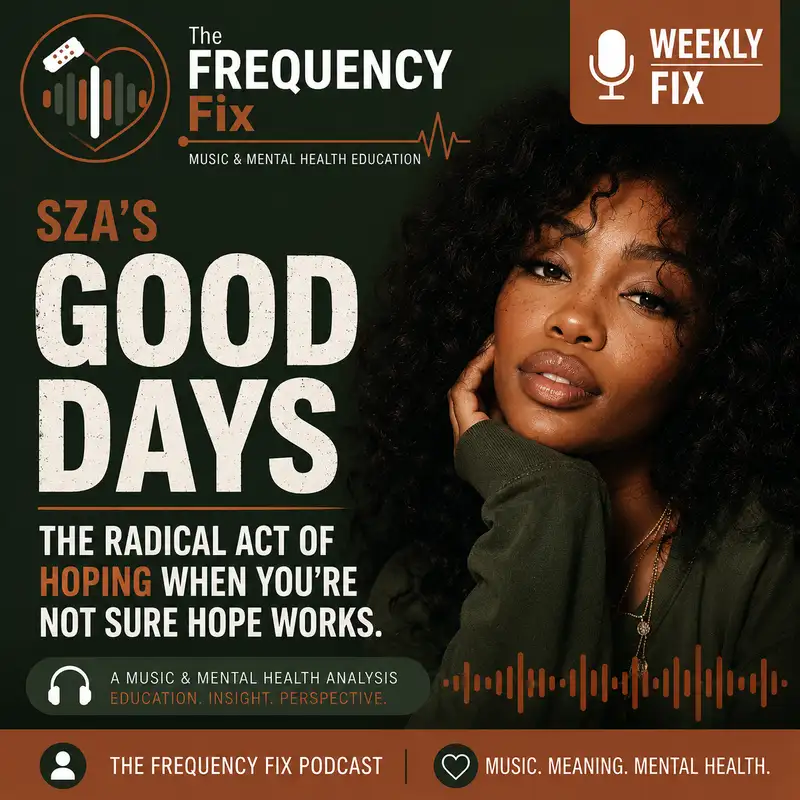
SZA's "Good Days" Explained | Overthinking, Emotional Exhaustion & Disciplined Hope
There's a version of a good day that only exists in your mind.
A version where everything feels lighter. Calmer. Less overwhelming.
You've probably been there before.
The question SZA asks in today's song is:
How do you get from the good day in your mind to the good day in your life?
And what do you do when the answer is: Not yet.
Welcome back to The Weekly Fix.
I'm John, LMSW.
Every week: One song. One emotional theme. One clinical breakdown.
And today's episode is about the part of healing nobody posts online—the messy middle.
The part where you're trying to get better and still struggling.
Why This Song Matters
SZA released Good Days on Christmas Day 2020, a time when many people were isolated,
grieving, exhausted, and trying to hold themselves together.
Into that moment she released a song about something many people were quietly asking
themselves:
What if hope doesn't feel available right now? Can I keep going anyway?
SZA's Own Words
SZA once described this song as “a mantra, more than a belief.”
That distinction changes everything.
This song isn't about certainty. It's about choosing to keep reaching toward something better even
when certainty never arrives.
Who This Episode Is For
This episode is for the person doing the work but still struggling, the person who feels guilty for not
being further along, the person who keeps overthinking, and the person who is tired of carrying their
own mind.
If that's you, stay with me.
Before The Lyrics
Before we talk about the words, let's talk about the sound.
Because Good Days communicates something important before SZA ever sings.
The production feels warm, dreamlike, open, and safe.
It's not trying to erase difficult emotions. It's creating room for them.
The Nervous System
From a nervous system perspective, this song does something rare.
It creates safety while making room for sadness, and hope while making room for struggle.
Most songs choose one. This song chooses both.
The Story Behind The Song
Another reason this song resonates is because it wasn't written all at once.
SZA started writing pieces of it years before it was released. It evolved across different seasons of
life.
That's what healing looks like too.
Not one breakthrough, but a series of small pieces that eventually begin to make sense together.
Why The Song Became An Anthem
People connected with Good Days because it didn't pretend recovery was simple.
It spoke honestly about uncertainty, and that honesty felt comforting.
Not because it solved anything, but because it made people feel less alone.
What's Really Happening Here?
This song isn't primarily about happiness. It's about rumination—the experience of getting stuck
inside your own thoughts.
What Is Rumination?
Rumination happens when the mind repeatedly returns to the same worries, regrets, fears, and
unanswered questions.
Not because you're choosing to. Because the brain believes it hasn't solved something yet.
What makes this song powerful is that it captures the real experience of healing—not the polished
version, but the real version.
The pattern often looks like this:
Rumination → Resistance → Exhaustion → A Small Act of Hope → Trying Again
The Listener Mirror
This song is for the overthinker, the person replaying old conversations, the person who feels stuck,
the person whose healing isn't linear, and most importantly, the person who still wants to believe
things can get better.
Rumination
The central psychological concept in this song is rumination.
Rumination feels productive. It feels like problem-solving. But it isn't.
Problem-solving moves forward. Rumination moves in circles.
Why It Happens
The brain believes that if it keeps revisiting the problem, it will eventually discover the answer.
Instead, many people become trapped inside the same loop.
Five Powerful Themes Inside The Song
1. The Good Day Exists Before The Circumstances Change
The good day begins internally, not externally.
2. Thoughts Are Not Facts
Recurring thoughts are not automatically true simply because they repeat themselves.
3. Difficult Seasons Are Survivable
Struggle is not proof of failure. It's proof that you're living through something hard.
4. Acceptance Is Not Giving Up
Acceptance means acknowledging reality without allowing reality to define your future.
5. The Present Moment Still Matters
One of the most healing practices available to us is learning to notice what is good today—not
someday, but today.
Hope As A Discipline
There are two types of hope.
The first is emotional hope—the feeling that things will improve.
The second is disciplined hope—the decision to keep moving toward something better even when
the feeling isn't there.
That's what SZA is describing.
Not hope as a feeling, but hope as a practice.
Emotional Exhaustion
The song also captures emotional fatigue—the exhaustion that comes from carrying difficult
thoughts for a long time.
If you've experienced that, you're not failing. You're tired.
Toxic Positivity vs. Disciplined Hope
Toxic positivity says: Ignore your pain. Focus on the positive. Think happy thoughts.
This song does none of that.
Instead it says: The pain is real. The uncertainty is real. And I'm still choosing to believe something
better is possible.
That's not denial. That's resilience.
Reflection Question
When you imagine a better version of your life, what are you actually hoping for?
And is there a small piece of that already available today?
Not the entire future. Just a sliver.
The Reframe
Healing is not a destination. It's a direction.
You don't need certainty, confidence, or even hope to move toward it.
You just need to keep showing up.
Practical Invitation
Before the day ends, identify one good moment.
A conversation. A meal. A walk. A laugh. A moment of quiet.
Notice it. Name it. Let it count.
Because good days aren't always entire days. Sometimes they're moments.
And sometimes that's enough.
This Week's Fix
SZA wrote this song across multiple years. It came together slowly, piece by piece.
Maybe that's why it resonates so deeply.
Because healing rarely arrives all at once.
It's built moment by moment, choice by choice, day by day.
This has been The Weekly Fix.
And this week's fix was SZA's Good Days and the psychology of rumination, emotional exhaustion,
and disciplined hope.
If this frequency met you where you are today, follow the show and share it with someone who may
need it.
And remember:
Music is like medicine.
Here's your fix.