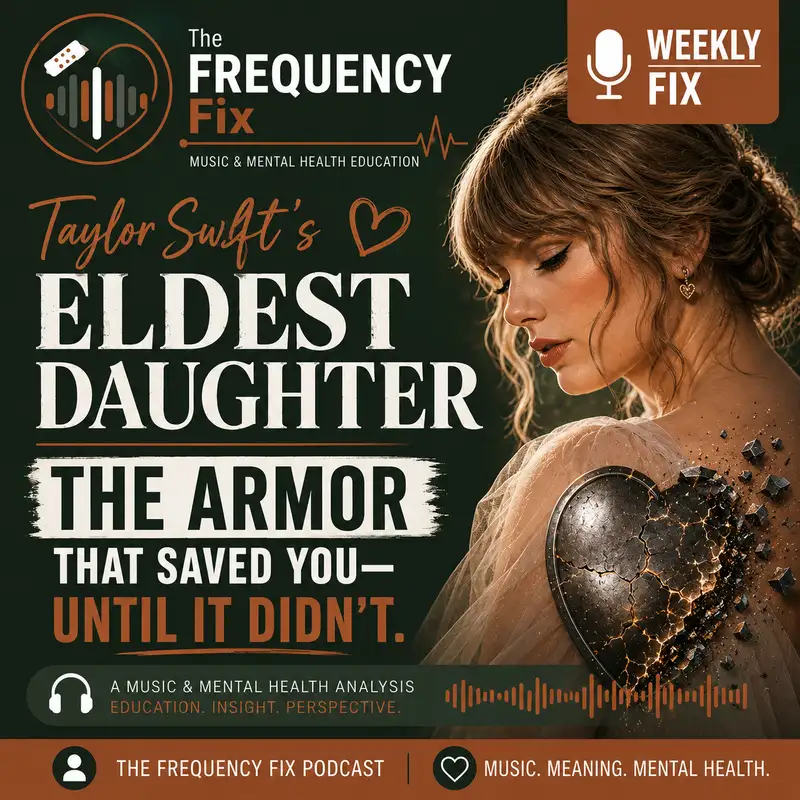
Taylor Swift's "Eldest Daughter" Explained | Parentification, Family Roles & Emotional Armor
Picture a child.
Maybe eight. Maybe ten.
Learning that the fastest way to make a room feel safe is to smile.
Not because they're okay.
But because if they smile, everyone else relaxes.
And a relaxed room feels safer than an upset one.
That child didn't learn manipulation. They learned survival.
And twenty years later, they're very good at smiling. And very tired.
Welcome back to The Weekly Fix.
I'm John, LMSW.
Every week: One song. One emotional theme. One clinical breakdown.
And this week, we're talking about Taylor Swift's Eldest Daughter.
Why This Song Matters
Taylor Swift released Eldest Daughter as Track 5 on The Life of a Showgirl.
If you're familiar with Taylor Swift's music, you know Track 5 is usually where the emotional armor
comes off—the most vulnerable and honest song on the record.
This one explores something she has described as almost universal among eldest daughters: the
pressure to become strong before you're ready.
Who This Episode Is For
This episode is for the responsible one, the oldest child, the family fixer, the person everyone
depends on, and anyone who learned to hold everything together.
Especially anyone wondering: Who am I when I'm not carrying everyone else?
Before The Lyrics
Before we talk about the words, let's talk about the sound.
Eldest Daughter is built around piano and acoustic guitar. No walls of production. No distractions.
No armor.
The music mirrors the emotional experience. It sounds like someone finally putting down a role
they've carried for years.
Two Stories Happening At Once
This song operates on two levels.
The first is personal: the experience of being the child who became responsible too early.
The second is cultural: the pressure many people feel to appear unaffected, independent, and
strong—even when they're struggling.
Why The Song Resonated
People from every background connected to this song—parents, siblings, caregivers, and adults
across generations.
Because the eldest daughter's experience isn't really about birth order. It's about responsibility.
It's about becoming the emotional adult before you were ready.
What's Really Underneath This Song?
This song isn't simply about pressure. It's about parentification.
A pattern that begins when a child takes on emotional or practical responsibilities that exceed what
they were developmentally prepared to carry.
The Emotional Arc
What makes this song powerful is that it doesn't just describe the wound. It describes the entire
journey.
First comes responsibility.
Then the armor.
Then the performance.
Then something unexpected: safety.
The pattern often looks like this:
Parentification → Armor → Emotional Self-Reliance → Performed Strength → A Safe Relationship
→ Learning To Receive
The Listener Mirror
This song is for people who struggle to ask for help, minimize their own needs, feel guilty receiving
support, or feel anxious when someone genuinely cares for them.
Not because they don't want love—but because they're not used to it.
When Safety Feels Uncomfortable
One of the hardest parts of healing is realizing that safety can feel unfamiliar.
Sometimes the nervous system becomes so accustomed to responsibility that rest feels
uncomfortable. Support feels uncomfortable. Being cared for feels uncomfortable.
Not because it's wrong. Because it's new.
Parentification
Parentification occurs when a child becomes responsible for responsibilities that belong to adults.
Sometimes that means caregiving. Sometimes emotional support. Sometimes conflict
management. Sometimes becoming the family's emotional anchor.
Why It Happens
The child adapts. They become capable, responsible, reliable, and often highly successful.
But the cost is that their own needs become difficult to identify.
The Armor
Over time, strength becomes identity.
You stop asking, “How do I feel?” and start asking, “What needs to be done?”
That's the armor.
Terminal Uniqueness
One of the most clinically interesting ideas in this song is the concept of feeling fundamentally
different from everyone else.
Not because you're special—but because you've convinced yourself nobody could possibly
understand.
And if nobody can understand, you never have to risk being fully known.
The Nervous System & Safety
If you grew up earning love through responsibility, unconditional care can actually feel
uncomfortable.
The nervous system doesn't automatically recognize safety. It recognizes familiarity.
And sometimes chaos feels more familiar than peace.
The Firstborn Experience
Whether you're an eldest daughter, oldest child, only child, or simply the person who became
responsible too early, the pattern is often the same.
You learned to survive by becoming dependable.
The question becomes: Can you learn to receive?
Reflection Question
When did you first learn that being open wasn't safe?
Take your time with that.
Most people can trace the armor back to a moment, a relationship, an experience, or a turning
point.
The Reframe
The armor worked. It protected you. It helped you survive.
You don't need to hate it. You don't need to fight it.
You simply need to recognize that the danger it was built for may no longer be here.
Practical Invitation
This week, think about one person in your life who consistently shows up for you.
When they offer support, don't immediately redirect. Don't minimize. Don't change the subject.
Just receive it—even for a moment.
That's where healing begins.
This Week's Fix
At its core, Eldest Daughter is not a song about strength. It's a song about endurance.
And endurance is not the same thing as being okay.
The armor helped you survive. But survival and connection are not the same thing.
Maybe the next chapter isn't about becoming stronger.
Maybe it's about becoming reachable.
This has been The Weekly Fix.
And this week's fix was Taylor Swift's Eldest Daughter and the psychology of parentification,
emotional responsibility, and learning to put the armor down.
If this frequency met you where you are today, follow the show and share it with someone who may
need it.
And remember:
Music is like medicine.
Here's your fix.